Balance sheet basic components
Great work on the previous lesson and exercises. Taking the first step is the hardest part, so congratulations! In this lesson, we will cover the basic components of the balance sheet. Let’s get started!
The Solvency II balance sheet is designed to answer a simple but fundamental question: does the insurance company have enough financial resources to meet its obligations, even in adverse situations? To answer this, Solvency II uses a market-consistent view of both assets and liabilities and focuses strongly on risk and uncertainty.
In this lesson, we look at the main components on the liabilities side of the Solvency II balance sheet. These components form the backbone of solvency assessment and will appear repeatedly throughout the course.
Main components
At a high level, the liabilities under Solvency II consist of three key elements:
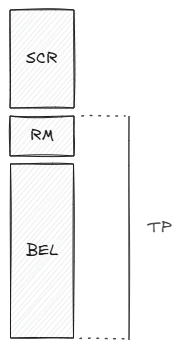
- Best Estimate Liabilities (BEL),
- Risk Margin (RM),
- Solvency Capital Requirement (SCR).
Each of these components plays a different role and answers a different question.
Best Estimate Liabilities
Best Estimate Liabilities represent the expected value of future insurance obligations. They reflect what the insurer expects to pay to policyholders, on average, over the lifetime of existing contracts. BEL are based on best estimate assumptions, meaning assumptions that reflect expected future experience without prudence margins. They include future benefits, premiums, expenses and charges, all projected into the future and discounted to today using risk-free interest rates. BEL are therefore forward-looking and neutral in nature - neither optimistic nor conservative.
Risk Margin
However, expected values alone do not capture uncertainty. Even if assumptions are well chosen, actual experience will almost never match the average exactly. This is where the Risk Margin comes in. Risk Margin reflects the cost of holding capital for risks that cannot be fully hedged away. It represents an additional amount on top of BEL that accounts for the uncertainty surrounding future outcomes. By separating BEL and Risk Margin, Solvency II makes a clear distinction between expected obligations and the cost of uncertainty.
Technical Provisions
Best Estimate Liabilities and Risk Margin are often grouped together under the name Technical Provisions. Technical Provisions therefore represent the total value of insurance liabilities under Solvency II. They answer the question of how much money the insurer needs today to cover its expected obligations while allowing for uncertainty.
Solvency Capital Requirement
Even Technical Provisions, however, are not sufficient to ensure solvency in extreme situations. Insurance companies can face sudden and severe losses over a short period of time, for example due to market shocks or unexpected claims. To protect against such scenarios, Solvency II introduces the Solvency Capital Requirement. SCR represents an additional capital buffer held on top of Technical Provisions. It is calibrated to ensure that the insurer can survive very adverse events with a high level of confidence.
In summary, the three main components of the Solvency II balance sheet serve complementary purposes. Best Estimate Liabilities capture expected outcomes, Risk Margin reflects uncertainty around those outcomes, and SCR provides protection against extreme one-year losses. Together, they form the core structure that allows solvency to be assessed in a consistent and risk-based way.
In the next lesson, we will build on this structure and introduce additional components and metrics that are used to assess solvency. But before that, let's tackle some questions.