Other components and metrics
Fabulous work so far! You've done a great job covering the main elements of the Solvency II balance sheet: Best Estimate Liabilities, Risk Margin, and the Solvency Capital Requirement.
In this lesson, we introduce Own Funds, Free Surplus, and the SCR coverage ratio.
Own Funds
Own Funds represent the capital available to absorb losses. In simple terms, they show how much value remains for the insurer after all liabilities have been taken into account.
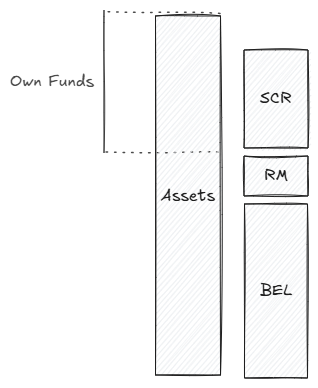
Own Funds are determined by the difference between assets and Technical Provisions on the Solvency II balance sheet. They change over time as asset values move, liabilities are remeasured or capital actions take place. Own Funds play a central role in solvency assessment because they are the resources used to cover the Solvency Capital Requirement.
Free Surplus
Another widely used solvency measure is Free Surplus. Free Surplus represents the amount of capital held in excess of the Solvency Capital Requirement.
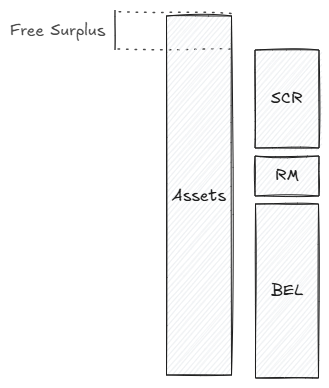
It is calculated as the difference between Own Funds and SCR. Free Surplus provides a useful indication of financial flexibility. A positive Free Surplus suggests that the insurer has additional capital available beyond regulatory needs, while a negative value indicates a shortfall.
SCR coverage ratio
While Own Funds show how much capital is available, they do not by themselves indicate whether this amount is sufficient. To assess adequacy, Solvency II commonly uses the SCR coverage ratio.
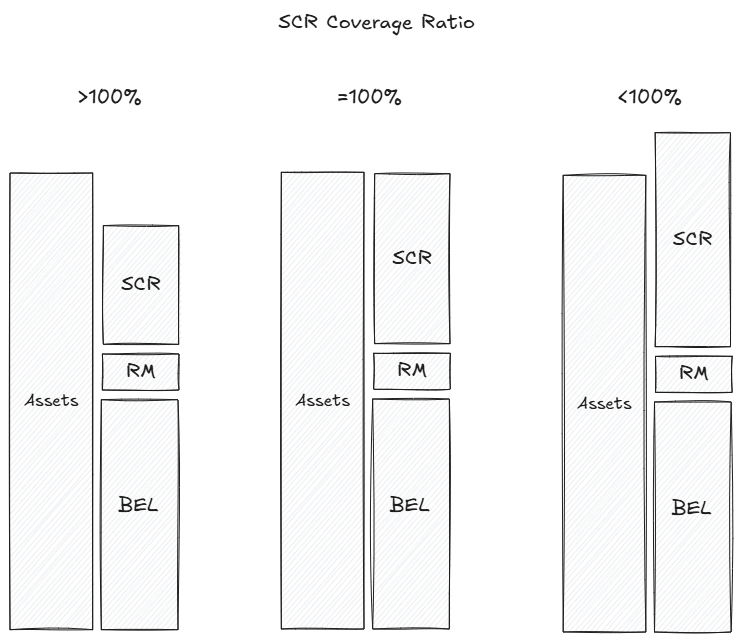
The SCR coverage ratio compares Own Funds to the Solvency Capital Requirement. It expresses, in a single number, how well the required capital is covered. A coverage ratio of 100% means that Own Funds are exactly equal to SCR. A ratio above 100% indicates a surplus of capital, while a ratio below 100% signals that the insurer does not meet regulatory capital requirements.
This completes the first chapter of the course and provides all the building blocks needed to explore Best Estimate Liabilities, Risk Margin, and the SCR in more detail in the following chapters. But before we do that, let’s do some maths!