Risks covered by the Solvency Capital Requirement
You're becoming an actuarial ninja - amazing work! Now let's take a look at the SCR risks.
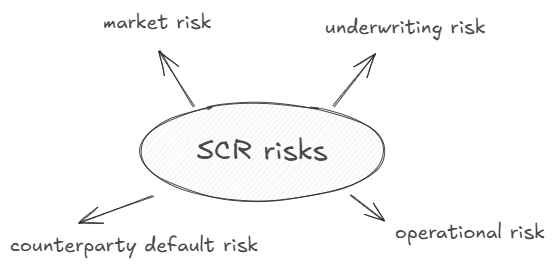
In the previous lesson, we introduced the Solvency Capital Requirement as a buffer against extreme losses over a one-year horizon. To understand what SCR really measures, it is important to look at which types of risk it is designed to cover. SCR is not focused on a single source of uncertainty. Instead, it captures a broad range of risks that could threaten an insurer's solvency within one year.
Market risk
A large part of SCR is driven by market risk. Market risk arises from changes in financial markets and affects the value of assets and, in some cases, liabilities. Examples include movements in interest rates, equity prices, property values, exchange rates and credit spreads. Because insurers often hold significant asset portfolios, market risk is frequently one of the largest contributors to SCR.
Underwriting risk
Another important group is underwriting risk, which relates directly to the insurance business itself. For life insurance, underwriting risk includes uncertainty around mortality, longevity, lapses, expenses and extreme events such as catastrophes. For non-life insurance, it includes risks related to future premiums, the adequacy of existing reserves and catastrophic claims. Health insurance has its own underwriting risks, depending on whether products behave more like life or non-life business. These risks capture the possibility that claims and benefits turn out significantly worse than expected over the next year.
Counterparty default risk
SCR also includes counterparty default risk. This reflects the possibility that a counterparty, such as a reinsurer or a bank, fails to meet its obligations. Even if an insurer's own business performs as expected, losses can arise if a key counterparty defaults. Solvency II therefore explicitly requires capital to be held against this type of risk.
Operational risk
In addition, SCR covers operational risk, which arises from failures in systems, processes, people or from external events. Examples include system outages, fraud, legal issues or human error. Although operational risk is harder to quantify than market or underwriting risks, it can still lead to significant losses within a short period and is therefore included in the SCR framework.
All of these risks are assessed over a one-year time horizon and calibrated to extreme but plausible scenarios. SCR does not attempt to capture every possible long-term uncertainty. Instead, it focuses on the question of how bad things could get over the next year if several adverse developments occur at the same time.
In practice, the mix of risks covered by SCR depends on the nature of the insurer's business. A life insurer with long-term guarantees may be more exposed to market and longevity risk, while a non-life insurer may be more sensitive to catastrophe risk. SCR is designed to reflect these differences in risk profile.
In the next lesson, we will cover a numerical example of calculating SCR, but before we do that, let’s practise!